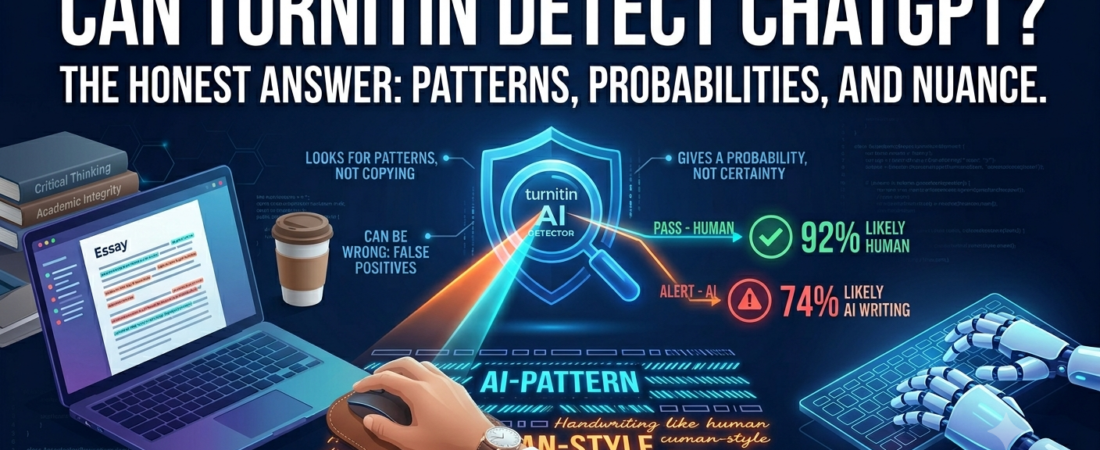
Yes, Turnitin can often detect ChatGPT, but not every time. Turnitin’s AI writing detector looks for patterns that are common in AI text, then gives an estimate of how much of your writing was likely generated by a tool like ChatGPT. It is a probability, not certainty, so it can both catch AI writing and wrongly flag human writing.
That nuance is the whole story. Turnitin is not searching the web for “the ChatGPT version” of your essay. It is judging the style of your writing. This guide explains how that works, why it is not foolproof, and what you should actually do before you hand your work in.
Key takeaways
- Turnitin can frequently detect ChatGPT style writing, but it can also miss it and flag human work by mistake.
- It detects patterns, not a copied source, which is why it differs from plagiarism checking.
- The AI score is separate from your similarity score.
- Heavily edited or paraphrased AI text is harder to detect, and detection is not guaranteed.
- You can see your AI score before submitting to know where you stand.
How does Turnitin detect ChatGPT?
Turnitin uses an AI writing detector that studies the patterns in your text. AI writing tends to be very smooth and predictable, with even sentence lengths and familiar phrasing. The model picks up on those traits and estimates how much of your work looks machine generated.
This is different from plagiarism detection. A plagiarism check finds text that matches an existing source. The AI detector does not need a source at all. It only judges whether the writing pattern resembles AI. We explain that second number in full in the Turnitin AI score explained.
So when people ask if Turnitin “finds” their ChatGPT essay, the honest answer is that it flags writing that looks like AI. It does not pull up a matching ChatGPT document.
Is Turnitin always right about ChatGPT?
No, and Turnitin says so itself. The company states that its AI model may not always be accurate and should not be the only reason a student faces action. That is a meaningful admission, because it confirms what students already see in practice. The report can be wrong in both directions.
Here is how the two error types play out:
| Situation | What happens | Why it matters |
| AI writing flagged correctly | ChatGPT text gets a high AI score | The detector worked as intended |
| AI writing missed | Edited or paraphrased AI text scores low | Detection is not guaranteed |
| Human writing flagged | Genuine work gets a high AI score | This is a false positive, and it happens |
Turnitin has noted that false positives are more common in the low score range, which is why a score between 1 and 19% shows an asterisk. We cover that quirk in what the asterisk means.
Why did Turnitin flag my essay as AI when I wrote it myself?
Because the detector reacts to writing style, not intent. If your writing is clear, formal, and smooth, it can share the same patterns the model links to AI. That makes some genuine human work look machine made.
A few things commonly raise the score:
- Very formal or formulaic academic writing.
- Flat sentence structure where every sentence is a similar length.
- Editing tools like Grammarly or a paraphraser changing your phrasing.
- Writing in a second language, which can be read as more uniform.
If this has happened to you, read why Turnitin flags human writing as AI for the full picture and how to respond.
Can Turnitin detect ChatGPT if I paraphrase or edit it?
Sometimes, but it gets harder. Turnitin has a category specifically for text that may have been AI generated and then changed with a paraphraser or bypass tool. So heavy editing can lower a score, but it does not guarantee a clean result, and the detector may still flag the AI paraphrased pattern.
We explain those two detection categories in AI generated versus AI paraphrased. The key point is that relying on edits to slip past a detector is risky and unreliable.
Can Turnitin detect other AI tools too?
Yes. Because Turnitin detects patterns rather than a specific tool, it is not limited to ChatGPT. It can flag writing from other models in a similar way. We answer the common questions in these guides:
- Can Turnitin detect QuillBot and paraphrasing tools
- Can Turnitin detect Grammarly
- Can Turnitin detect Gemini and Claude
What should I do before I submit?
The smartest move is to check your work early and write in your own voice. If you use AI to help, revise the text so it reflects your own thinking, add your own analysis, and vary your sentences. This is about producing honest work, not about beating a detector.
It also helps to compare how different detectors read your writing, since scores vary so much between tools. Our comparison of Turnitin versus GPTZero shows why one number should never be treated as the final truth.
How can I see my Turnitin AI score before submitting?
Most students cannot. The AI report is usually controlled by the instructor, and you only see it after submitting, when it is too late to revise. We explain this in can students check Turnitin before submitting.
Plag Check closes that gap. Upload your document and get the same similarity and AI report your professor sees, in about 15 minutes, with no account and no risk of your paper being stored in a university database. Check your work now.
Frequently asked questions
Can Turnitin detect ChatGPT?
Often yes. Turnitin’s AI detector can frequently flag ChatGPT style writing based on its patterns, but it can also miss edited AI text and wrongly flag human writing.
Does Turnitin find the actual ChatGPT source?
No. Turnitin does not search for a matching ChatGPT document. It estimates how much of your writing looks AI generated based on style.
Can Turnitin be wrong about AI?
Yes. Turnitin states its AI model is not always accurate and should not be the sole basis for action against a student. False positives are more likely in the low score range.
Can Turnitin detect ChatGPT if I edit it?
Sometimes. Heavy editing can lower the score, but Turnitin has a category for AI paraphrased text, so detection is still possible and never guaranteed.
Is the AI score the same as plagiarism?
No. The AI score measures how much of your writing looks AI generated. The similarity score measures matching text. They are separate numbers.